The 1099-NEC deadline is not January 31 in 2027. That is a Sunday, so it is Monday, February 1. Two more dates move, one of them for a federal holiday most calendars forget. Every date below is computed, and the deadline finder does the same for any form or year.
- 1099-NEC
- Mon Feb 1, 2027 · recipient and IRS
- Most recipient copies
- Mon Feb 1, 2027
- Feb 15 forms
- Tue Feb 16, 2027
- IRS paper
- Mon Mar 1, 2027
- IRS e-file
- Wed Mar 31, 2027
- Apply for a TCC by
- Fri Dec 18, 2026
- E-file threshold
- 10 or more returns
The season, end to end
Two of the dates that decide this season fall in 2026.
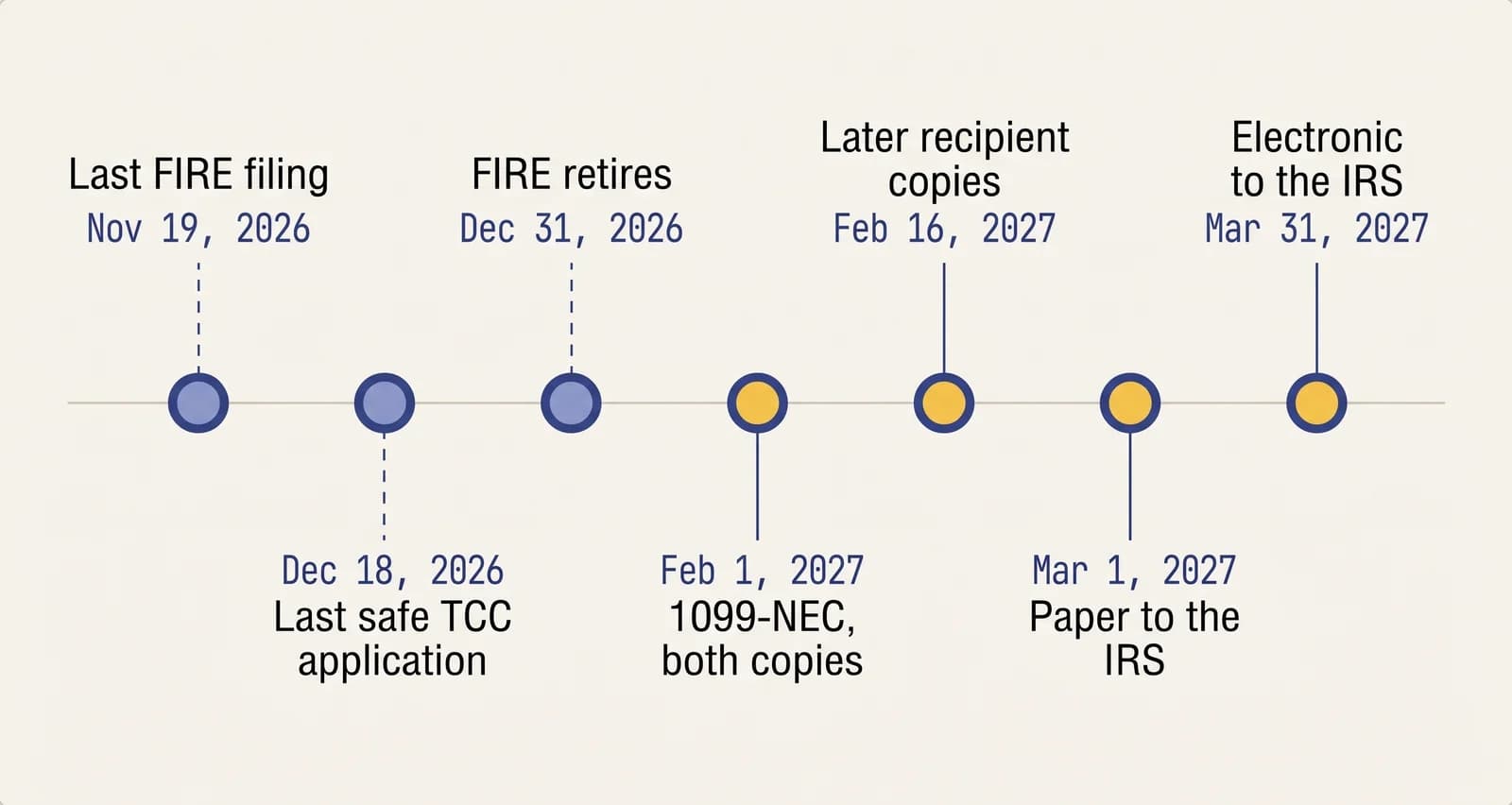
- Last FIRE filing. The IRS stops accepting production files through FIRE at 3 p.m. ET.
- Last safe TCC application. 45 calendar days before Mon Feb 1, 2027, the first IRS deadline. Apply later and the code may not arrive in time.
- FIRE retires. IRIS is the only electronic route from January 1.
- 1099-NEC, both copies. 1099-NEC to recipients and to the IRS on the same day, plus the recipient copies of most other forms.
- Later recipient copies. 1099-B, 1099-DA, 1099-S, consolidated statements, and 1099-MISC with an amount in box 8 or 10.
- Paper to the IRS. Everything except 1099-NEC. Paper is only an option below 10 returns in total, or with an IRS-approved hardship waiver.
- Electronic to the IRS. Everything except 1099-NEC. The date most filers work to.
FIRE stops accepting production files at 3 p.m. ET on Thursday, November 19, 2026 and retires on Thursday, December 31, 2026. Everything after that goes through IRIS, including prior-year returns and corrections.
An IRIS Transmitter Control Code takes up to 45 calendar days, which puts the last safe application on Friday, December 18, 2026. A direct API filer also needs a certificate, an API Client ID, and a passing assurance test. Filing through a transmitter who already holds a TCC skips all of it.
Why the 2027 dates move
The general instructions for information returns move a due date that lands on a Saturday, Sunday, or legal holiday to the next business day. Three land badly in 2027.
February 15 is the one that gets missed: it is already a Monday, so it does not look like it needs moving.
Every form, with its own dates
Tax year 2026 returns, filed in 2027. A star marks a date that moved.
| Form | To recipients | IRS paper | IRS electronic |
|---|---|---|---|
| 1099-NEC | * | * | * |
| 1099-MISC | * | * | |
| 1099-MISC (amount in box 8 or 10) | * | * | |
| 1099-INT | * | * | |
| 1099-DIV | * | * | |
| 1099-R | * | * | |
| 1099-B | * | * | |
| 1099-S | * | * | |
| 1099-DA | * | * | |
| 1099-K | * | * | |
| 1099-G | * | * | |
| 1099-C | * | * | |
| 1098 | * | * | |
| 1098-T | * | * |
* Moved to the next business day. Export these from the deadline finder, and confirm against the IRS tax calendar and Publication 509 once the tax-year 2026 versions publish: per-form instructions can carry their own exceptions.
1099-NEC is the one to plan around
- 01
1099-NEC has no extra filing time
Every other form gives you until March 31 to file electronically. 1099-NEC gives you the same day as the recipient copy, the earliest deadline of the season.
- 02
The 30-day automatic extension does not apply to it
Form 8809 buys an automatic 30 days for most forms. Not for 1099-NEC or W-2. You may request one before the due date, for a listed reason, and be refused.
- 03
It is the form most firms file most of
Contractor payments are the bulk of a typical practice's volume, so the tightest deadline governs the largest pile. Plan around February 1, not March 31.
What an extension does and does not buy
Two extensions, two forms. Form 8809 covers the IRS copy, Form 15397 the recipient copies. Neither covers the other.
- Form 8809, most forms
- Automatic 30 days to file with the IRS, to Friday, April 30, 2027 for the March 31 forms. File it by the due date.
- Form 8809, 1099-NEC
- Not automatic. Requested on paper before Monday, February 1, 2027, granted only for the reasons listed on the form, and capped at one 30-day extension.
- Form 15397
- Up to 30 more days to furnish recipient copies. Sent by fax only, never by mail or online, and it must reach the IRS by the recipient due date.
- Neither extension
- Moves the other one. An extension to file does not delay the recipient copies, and the reverse is also true.
What late costs
Per return, and a late recipient copy carries its own penalty of the same size. Two hundred forms missed by a month is a five-figure problem. These are the figures for returns due in 2027, from Rev. Proc. 2025-32.
- Within 30 days
- $60 per return
- 31 days to August 1
- $130 per return
- After August 1
- $340 per return
- Intentional disregard
- $690 per return, or more, no cap
They are inflation-adjusted each year: check the IRS penalties page, Publication 1099, or the IRM for current numbers. Small filers have lower annual caps, and reasonable cause can abate a penalty. Neither helps with a date you forgot. The 1099 penalties guide works the full cost with three computed examples. To price your own dates, run the 1099 penalty calculator, which finds the tier from the filing or correction date.
The state deadline is a separate problem
IRIS carries the Combined Federal/State Filing program forward from FIRE. Section 9 of Publication 5718 lists the eleven forms it covers and the states that take a forwarded return. A forwarded return is one upload you may not have to do twice. It is not the state being handled. Massachusetts participates and still requires annual reports “filed directly with DOR even if the transmitter participates” in the program (Mass.gov, July 24, 2026).
We publish no state date table: the participating list changes every year, and most states had not published 2027 dates as of September 2026. Check Publication 5718 and the CF/SF FAQs each season, then the revenue department of every state you file into.
Four ways firms lose this season
- 01
Writing January 31 on the plan
It is a Sunday. Build a workflow or a client letter on it and February 1 starts looking late to everyone who reads it.
- 02
Treating the season as one deadline
1099-NEC is due to the IRS two months before the rest. Work to March 31 and you miss the only date that matters early.
- 03
Filing on paper without counting
Ten or more information returns in total must be filed electronically, and the count aggregates across form types. Six 1099-NECs and five 1099-INTs is over the line.
- 04
Treating a transmitted file as a filed return
A transmission gets a receipt, then an acknowledgement. They are different. A schema-rejected transmission cannot be replaced: it is refiled as a new original, on a new date.
What makes 2027 different
The dates are close to normal. The system is not. These are the first returns that must go through IRIS, so February 1 arrives with a format change, possibly a credential application, and your largest pile of forms at once. Settle the route before the holidays: the FIRE-to-IRIS guide compares all three, and the TCC walkthrough covers the one with a queue.
Then check the file you already produce. The FIRE file validator reads a Publication 1220 file in your browser and reports errors by row. A bad TIN found in August costs nothing. The same TIN on February 1 costs $60 a return and rising.
Questions
- What is the 1099-NEC deadline for 2027?
- Monday, February 1, 2027, for both the recipient copy and the IRS copy. The statutory date is January 31, which falls on a Sunday in 2027, and a due date that lands on a weekend or legal holiday moves to the next business day.
- Why is the deadline February 1 and not January 31 in 2027?
- Because January 31, 2027 is a Sunday. The general instructions for information returns state that if a due date falls on a Saturday, Sunday, or legal holiday, filing or furnishing on the next business day is timely.
- When are 1099s due to the IRS if I file electronically?
- March 31, 2027 for most forms, which is a Wednesday and does not shift. The exception is 1099-NEC, which is due to the IRS on the same day as the recipient copy, February 1, 2027.
- Which 1099 forms get the later recipient deadline?
- 1099-B, 1099-DA, 1099-S, consolidated reporting statements, and 1099-MISC when an amount is reported in box 8 or 10. The statutory date is February 15, which in 2027 is Presidents Day, so it moves to Tuesday, February 16.
- Do I have to file 1099s electronically?
- If you file 10 or more information returns in total for the year, yes. The count aggregates across form types, so a mixed set can cross the threshold when no single type does. Below 10, paper is allowed, as it is with an approved hardship waiver.
- Can I get an extension on 1099 deadlines?
- Form 8809 gives an automatic 30 days for most information returns, but not for 1099-NEC or W-2, which need a request before the due date for a listed reason and can be refused. No extension to file moves the recipient copies; that is Form 15397.
- What are the penalties for filing 1099s late in 2027?
- For returns due in 2027 the tiers are $60 per return if corrected within 30 days, $130 if corrected after that but by August 1, and $340 if later, and at least $690 with no cap for intentional disregard (Rev. Proc. 2025-32). A second penalty of the same size applies to a late recipient copy.
- What is the last day to apply for an IRIS TCC for the 2027 season?
- Work back 45 calendar days from the first IRS deadline, which gives Friday, December 18, 2026 for the 2027 season. The IRS says to allow up to 45 calendar days to process an application for a Transmitter Control Code, and nothing about that queue speeds up in January. Filing through a transmitter who already holds a TCC removes the wait.
- Do I have to file 1099s with my state as well?
- Usually yes, and the Combined Federal/State Filing program does not settle it. The IRS forwards a covered return to a participating state, but the state sets its own requirements and dates, and some participating states still want the return or an annual reconciliation filed with them directly. Massachusetts is one: it requires the annual report even from filers who use the program.
- Does FIRE still work for the 2027 season?
- No. FIRE retires on December 31, 2026. Tax-year 2026 returns filed in early 2027 must go through IRIS, either the free Portal, your own A2A integration, or a transmitter filing on your behalf.
Last verified September 18, 2026 against the General Instructions for Certain Information Returns, Forms 8809 and 15397, IRC section 7503, Publications 5717 and 5718 (Processing Year 2026), and the IRS penalties page. Dates are computed, not typed: one engine drives the deadline finder, and its tests check them against the dates the IRS published for the 2026 season.